
Description
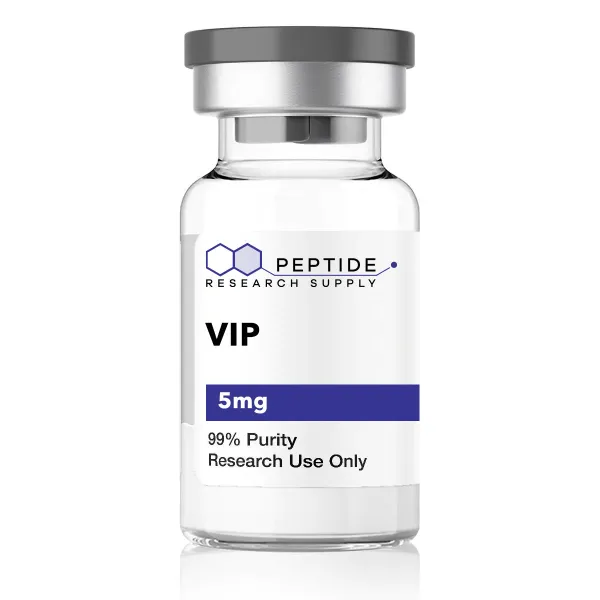
Vasoactive Intestinal Peptide (VIP) | Neuro-Immunology Research Reagent | USA
Product Specifications
- Product Name : Vasoactive Intestinal Peptide (Research Grade)
- Sequence : His-Ser-Asp-Ala-Val-Phe-Thr-Asp-Asn-Tyr-Thr-Arg-Leu-Arg-Lys-Gln-Met-Ala-Lys-Lys-Tyr-Leu-Asn-Ser-Ile-Leu-Asn-Gly
- Amino Acid Count : 28 AA
- Purity : ≥99% (HPLC Verified)
- Molecular Weight : ~3326.0 Daltons
- Form : Lyophilized Crystalline Powder
- Solubility : Soluble in water; adopts alpha-helical structure in membrane-mimetic solvents
- Storage : Store at -20°C, desiccated. Protect from oxidation (See Handling).
Disclaimer For Research Use Only (RUO). Not for human use.
Chemical Identity & Characteristics
Vasoactive Intestinal Peptide (VIP) is a 28-amino acid basic neuropeptide belonging to the glucagon/secretin superfamily. Originally isolated from the porcine duodenum in 1970, it is now recognized as a master “pleiotropic regulator” of the neuro-immuno-endocrine axis.
Structural Dynamics : In aqueous solution, VIP exists as a disordered random coil. Upon interaction with lipid membranes or receptor binding pockets, it undergoes a conformational transition into a stable alpha-helix (residues 10–23).
Receptor Binding : VIP binds with high affinity to two Class B G-protein-coupled receptors: VPAC1 (constitutive expression) and VPAC2 (inducible expression).
Sequence Homology : The peptide sequence is highly conserved across mammalian species, with human, bovine, and rat sequences being nearly identical, underscoring its evolutionary significance.
3D molecular structure of Vasoactive Intestinal Peptide

Scientific 3D molecular structure visualization of the 28-amino acid Vasoactive Intestinal Peptide (VIP), highlighting the characteristic alpha-helical core active domain and key side chain residues.
Analytical Validation & Certificate of Analysis (COA)
We prioritize analytical transparency for complex neuropeptides. The structural integrity of VIP—specifically the alpha-helix core—is critical for receptor efficacy.
HPLC Verification : Ensures purity(≥99%) and verifies the absence of truncated fragments (e.g., deletion of Thr11), which are known to abolish activity.
Mass Spectrometry (MS) : Confirms the molecular weight (~3326 Da) and amino acid sequence integrity.
Oxidation Control : The Methionine residue at position 17 (Met17) is highly susceptible to oxidation. Our production process is strictly controlled to prevent Met17-sulfoxide formation, which disrupts the hydrophobic face of the helix and destroys biological activity.
Storage, Stability & Handling (RUO)
CRITICAL HANDLING INSTRUCTIONS:
Oxidation Sensitivity : This peptide contains Methionine (Met17). Exposure to air can lead to oxidation. Keep vials tightly sealed and minimize freeze-thaw cycles.
Reconstitution : Reconstitute in sterile, bacteriostatic water or buffer. Use immediately or aliquot and freeze at $-20^{\circ}C$ or below.
Solvent Environment : Note that the peptide’s secondary structure is solvent-dependent. It forms a defined alpha-helix in the presence of phospholipids or membrane-mimetic solvents.
Research Context & Literature Overview
VIP is a subject of intense investigation in metabolic engineering, neurodegeneration, and immunology. Literature describes it as a “macrophage deactivation factor” and a key synchronizer of circadian rhythms.
Key Mechanisms of Action :
1 – Immunomodulation (The Th2/Treg Shift) :
VIP induces the differentiation of naïve T cells into FoxP3+ Regulatory T cells (Tregs), promoting immune tolerance.
It inhibits the NLRP3 inflammasome in macrophages, preventing the release of IL-1beta and IL-18.
2 – Neuroprotection :
Research in Parkinson’s disease (PD) models suggests that selective VPAC2 agonists (e.g., LBT-3627) protect dopaminergic neurons by downregulating microglial inflammation.
In Alzheimer’s models (5xFAD), VIP has been shown to reduce beta-amyloid plaque burden and prevent hippocampal atrophy.
3 – Pulmonary Physiology :
VIP is highly expressed on Alveolar Type II cells. Research indicates it upregulates surfactant production and may prevent “cytokine storms” in Acute Respiratory Distress Syndrome (ARDS) models.
Cited Research & Clinical Literature
The following citations are provided for educational and research contexts only.
European Journal of Neuroscience (2024) :
- Study : “Microglia cells treated with synthetic vasoactive intestinal peptide or transduced with LentiVIP protect neuronal cells against degeneration.”
- Summary : This pivotal 2024 study utilized synthetic VIP to demonstrate robust neuroprotection in in vitro models. It confirmed that VIP treatment shifts microglia from a pro-inflammatory to a neuroprotective phenotype, significantly reducing neuronal cell death in toxin-induced degeneration models.
ClinicalTrials.gov (2025) | NCT06466525 :
- Trial : “A Two-Part Single and Multiple Ascending Dose Trial… of LBT-3627 in Participants With Parkinson’s Disease.”
- Summary : Current Phase 1 clinical data verify the translational potential of VPAC2-specific VIP analogues. The trial serves as a proof-of-concept for the “neuro-immunomodulation” hypothesis, validating the pathway researchers are investigating using this reagent.
Frontiers in Immunology (2021) :
- Study : “Mechanism of Immunoregulatory Properties of Vasoactive Intestinal Peptide.”
- Summary : Detailed the peptide’s ability to inhibit Th1 differentiation and promote a tolerogenic state via Dendritic Cell modulation.
Why Researchers Source from Profound Aminos
Profound Aminos supplies research reagents with an emphasis on analytical transparency, lot-level documentation, and strict RUO compliance to support reproducible research.
- Sequence Integrity : We guarantee the full 28-amino acid sequence with specific attention to the stability of the Met17 residue.
- Lot-Specific COA : Every batch comes with data verifying HPLC purity and Mass Spec identity.
- USA-Based Supply Chain : Shipped directly from our USA facility to ensure peptide stability during transit.
Scientific Reference Disclaimer
The literature citations and research context provided above are strictly for scientific and educational purposes to describe the reagent’s mechanism of action and history in research. They do not imply efficacy, safety, or therapeutic use. This product is a chemical reagent and has not been approved for any medical application.
Regulatory & Compliance Statement
For Research Use Only (RUO):
This product is intended solely for laboratory research and development. It is not for human or veterinary use. This product acts as a chemical reagent and has not been approved for any medical application, therapeutic, or diagnostic use.
Frequently Asked Questions
Q: Is this VIP Acetate or Trifluoroacetate?
A: We supply research-grade Vasoactive Intestinal Peptide, typically as a Trifluoroacetate (TFA) salt for optimal stability and solubility. Please check the specific lot COA.
Q: Can this peptide be used for human trials?
A: No. This is a Research Use Only (RUO) reagent. It is not GMP-grade and is strictly for in vitro or animal model research.
Q: Why is Met17 important for my research?
A: Methionine at position 17 is part of the hydrophobic face of the peptide’s alpha-helix. If it oxidizes, the peptide cannot anchor to the receptor correctly, leading to false negatives in your assays.
Q: Does this peptide activate VPAC1 or VPAC2?
A: Native VIP binds with high affinity to both VPAC1 and VPAC2 receptors. It has very low affinity for the PAC1 receptor.

Reviews
There are no reviews yet.