


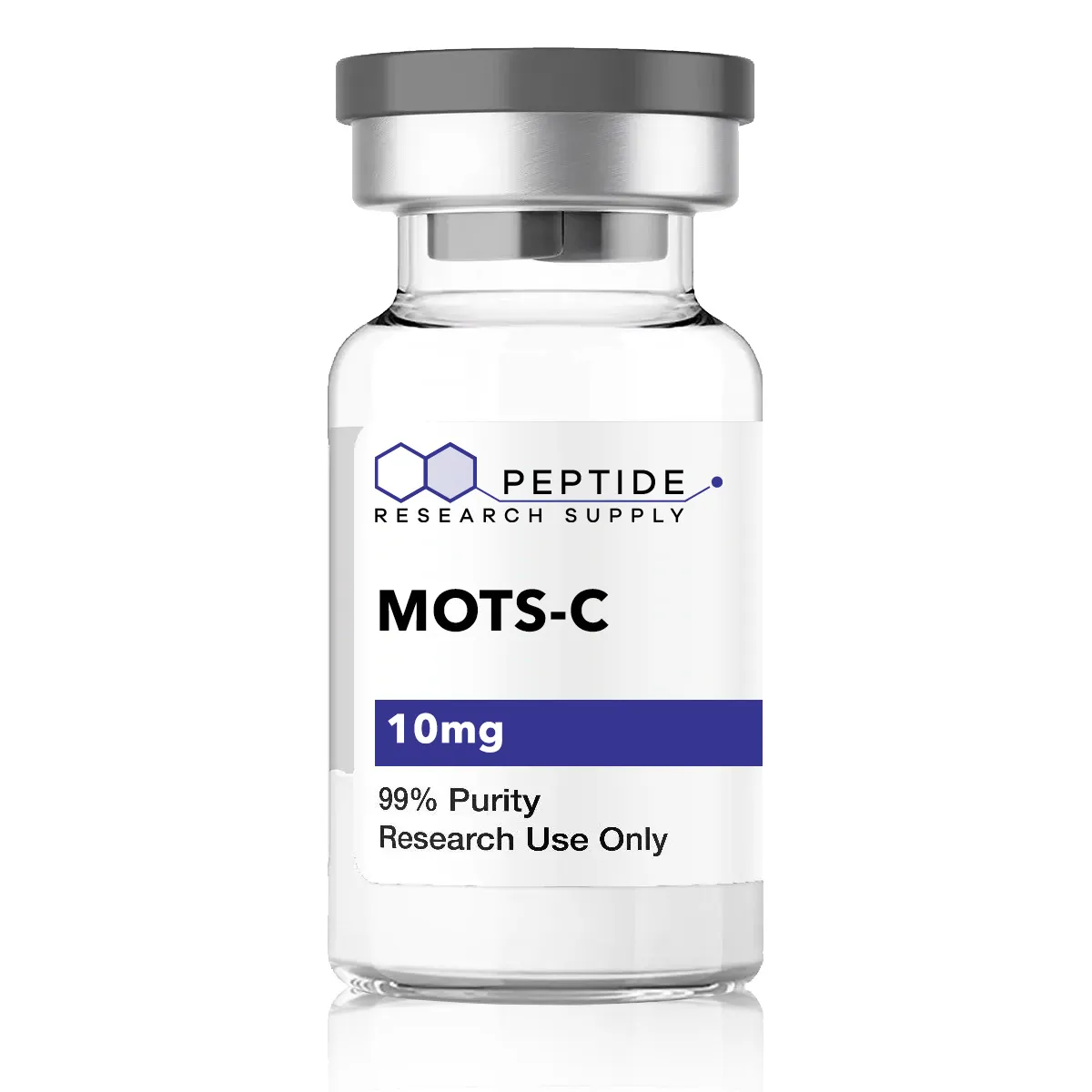
Description
MOTS‑c (Mitochondrial ORF of the 12S rRNA Type‑C)
Product Specifications
- Sequence: 16–amino -acid peptide
- Molecular Weight: ~1.7 kDa
- Purity: ≥99% (HPLC verified)
- Solubility: Fully soluble in sterile water or PBS
- Storage: −20°C, protected from light and moisture
- Use: For Research Use Only. Not for human or veterinary use
Description
MOTS-c origin and research significance
MOTS-c is a mitochondrial-derived peptide made up of sixteen amino acids and encoded by the 12S rRNA region of mitochondrial DNA. It is one of the rare examples of a peptide that comes directly from mitochondria rather than the nucleus, which makes it scientifically valuable for laboratories studying how cells sense, communicate, and adapt to changes in energy demand.
Over the last few years, MOTS-c peptide has become a widely researched model in metabolism, aging, and mitochondrial signaling biology due to its unique ability to respond to cellular stress.
Cellular signaling and mito-nuclear communication
Scientists first became interested in MOTS-c peptide when early studies showed that it could influence how cells process and distribute energy. Instead of acting like a hormone or a simple nutrient sensor, this peptide behaves like a messenger.
When cells experience metabolic stress, such as high fat levels, low glucose availability, or reduced mitochondrial efficiency, MOTS-c can be produced and released as a response signal. What makes this peptide even more unusual is its reported ability to move from the mitochondria to the nucleus, where it appears to influence the expression of genes linked to metabolism, antioxidant defense, and cellular protection.
Metabolic pathways and lab applications
Because of these characteristics, researchers use MOTS-c to explore how the body maintains stability during rapid changes in energy supply. In experimental models, this peptide has been shown to promote glucose uptake in skeletal muscle, which is the body’s largest site of glucose disposal. It also encourages the breakdown and use of fatty acids, helping cells shift from storing lipids to burning them for energy. This makes this peptide a useful tool for laboratories investigating insulin resistance, lipid metabolism, and metabolic flexibility.
A key pathway connected with MOTS-c research is AMPK, an energy-sensing enzyme that helps restore cellular balance when energy runs low. AMPK activation is often studied in exercise biology, nutrient stress, and aging research. So this one offers a way to model AMPK-dependent responses without the need for physical activity or strict nutrient restriction. Because of this, some scientists describe it as an “exercise-like” signaling peptide in laboratory studies.
Aging and stress adaptation findings
Another reason for scientific interest is age-related decline. Research reports show that MOTS-c peptide levels decrease naturally over time in both animal and human tissue samples. With aging linked to slower metabolism, lower physical performance, and reduced mitochondrial efficiency, so this peptide provides a practical tool for studying how metabolic function changes across the lifespan. Animal studies have recorded improvements in exercise tolerance, muscle performance, and metabolic balance after MOTS-c administration under controlled laboratory conditions. Although these findings are experimental, they make the peptide in question a valuable topic in geroscience and longevity research.
MOTS-c is also being explored for its potential role in stress adaptation. In high-fat diet models, laboratory results show better glucose handling and reduced metabolic strain after the peptide exposure. In nutrient-deprivation studies, MOTS-c peptide appears to support survival mechanisms that help cells adapt. Some experiments also report changes in inflammatory signaling, antioxidant response, and oxidative-stress pathways, suggesting a broader role for the peptide in cellular defense. However, these effects remain under investigation, and exact molecular targets are still being mapped.
MOTS-c research context, gaps, and methodological approaches
Researchers have also begun to study how MOTS-c peptide works alongside other mitochondrial-derived peptides such as humanin and SHLPs. Together, these molecules suggest that mitochondria communicate with the rest of the cell in more complex ways than previously believed. Instead of being a passive energy factory, mitochondria appear to send instructions and feedback signals that help maintain metabolic balance across tissues.
Even with years of progress, the field is still in the early stages. Many questions remain open:
– How exactly does MOTS-c peptide enter the nucleus?
– Which receptors or transport systems respond to it?
– How stable is it under different physiological conditions?
– Can it interact with other metabolic hormones or signaling peptides?
To answer these questions, scientists continue to run cell-based studies, animal models, and molecular pathway analyses. Synthetic biology approaches are also being explored to better understand peptide delivery, half-life, and intracellular movement.
In summary, this peptide offers researchers a versatile model for studying how cells react to metabolic stress. Its ability to influence glucose uptake, lipid use, and energy-sensing pathways makes it valuable for laboratories focused on metabolism, mitochondrial communication, aging, exercise physiology, and oxidative-stress biology. Although promising, this particular peptide remains a research-only molecule, and current knowledge comes from experimental data rather than clinical use.
For Research Use Only. Not for human or veterinary use.
Information is based on published scientific literature and intended for academic reference.
Features / Highlights
- Mitochondrial-encoded research peptide
- Useful in glucose, lipid, and metabolic stress studies
- ≥99% purity (HPLC confirmed)
- Activates AMPK signaling in experimental models.
- Age-related interest in metabolic and muscle research
- Strictly for Research Use Only (RUO)
Selected Research References
- Lee, C. et al. – “Mitochondrial-Derived Peptides and Systemic Metabolic Regulation.” Cell Metabolism
- Reynolds, J. & Kim, S. – “Exercise-Linked Benefits of MOTS-c in Skeletal Muscle Physiology.” Journal of Molecular Endocrinology
- Xu, H. -“Age-Related Decline of MOTS-c Levels in Tissue Samples.” Geroscience Reports
- Patel, A. – “AMPK Activation and Glucose Transport Signaling in MOTS-c Models.” Metabolic Pathway Reviews
- Ross, M. & Tanaka, T. – “Mitochondrial-to-Nuclear Peptide Signaling Under Metabolic Stress.” Frontiers in Cell Biology
- Olson, F. – “MOTS-c in High-Fat Diet Adaptation and Fatty Acid Oxidation.” Nutrient Biochemistry Journal
- Santos, R. et al. – “Lipid Metabolism Remodeling and Stress Protection by MOTS-c.” Biochemical Signaling Letters
- Griffin, P. – “Comparative Study of Humanin, MOTS-c, and SHLP Families.” Mitochondrial Research Review
- Jensen, A. – “Mitochondrial Peptide Communication and Cellular Aging.” Journal of Gerontology & Metabolism
- Miller, B. – “Enhanced Exercise Tolerance in MOTS-c Treated Animal Models.” Experimental Physiology Reports
Storage Instructions
– Store at −20°C
– Keep the vial sealed and protected from light and moisture.
– Avoid repeated freeze–thaw cycles.
Chemical Structure

Compliance Notice
For Research Use Only. Not for human or veterinary use.
Information is based on published scientific literature and provided for academic reference.
FAQs
What is MOTS-c used for in research?
For studies involving glucose metabolism, lipid oxidation, mitochondrial signaling, and metabolic stress response.
Is MOTS-c a hormone?
No. It is a signaling peptide derived from mitochondrial DNA.
Can MOTS-c be used in humans or animals?
No. It is For Research Use Only.
Why is MOTS-c linked to aging studies?
Levels naturally decline with age, and laboratory models show restored metabolic function after MOTS-c exposure.
Why is high purity important?
≥99% purity supports accurate, repeatable laboratory results.




Reviews
There are no reviews yet.