

Description
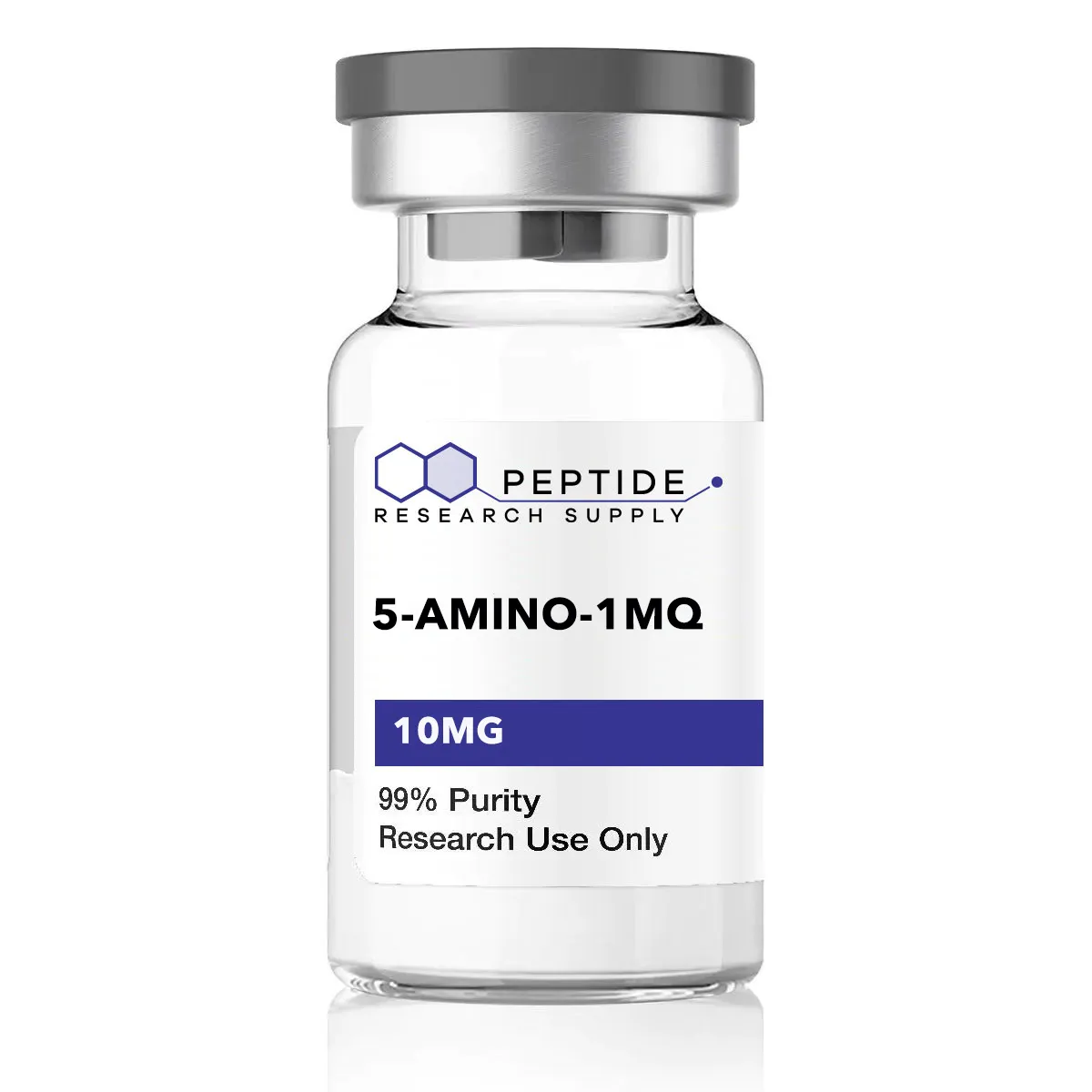
5 Amino 1MQ (Research Grade) – Small Molecule Reagent
TECHNICAL SPECIFICATIONS ( Research Blend)
- Product Name : 5 Amino 1MQ (Research Grade)
- Chemical Class : Methylquinolinium Derivative (Small Molecule)
- CAS Number : 42464-96-0 (Iodide Salt)
- Sequence : Tyr-Ala-Asp-Ala-Ile-Phe-Thr-Asn-Ser-Tyr-Arg-Lys-Val-Leu-Gly-Gln-Leu-Ser-Ala-Arg-Lys-Leu-Leu-Gln-Asp-Ile-Met-Ser-Arg
- Molecular Formula : C₁₀H₁₁IN₂ (Iodide Salt)
- Molecular Weight : 286.11 g/mol (Salt Form) [Ref: PubChem 2026 Update]
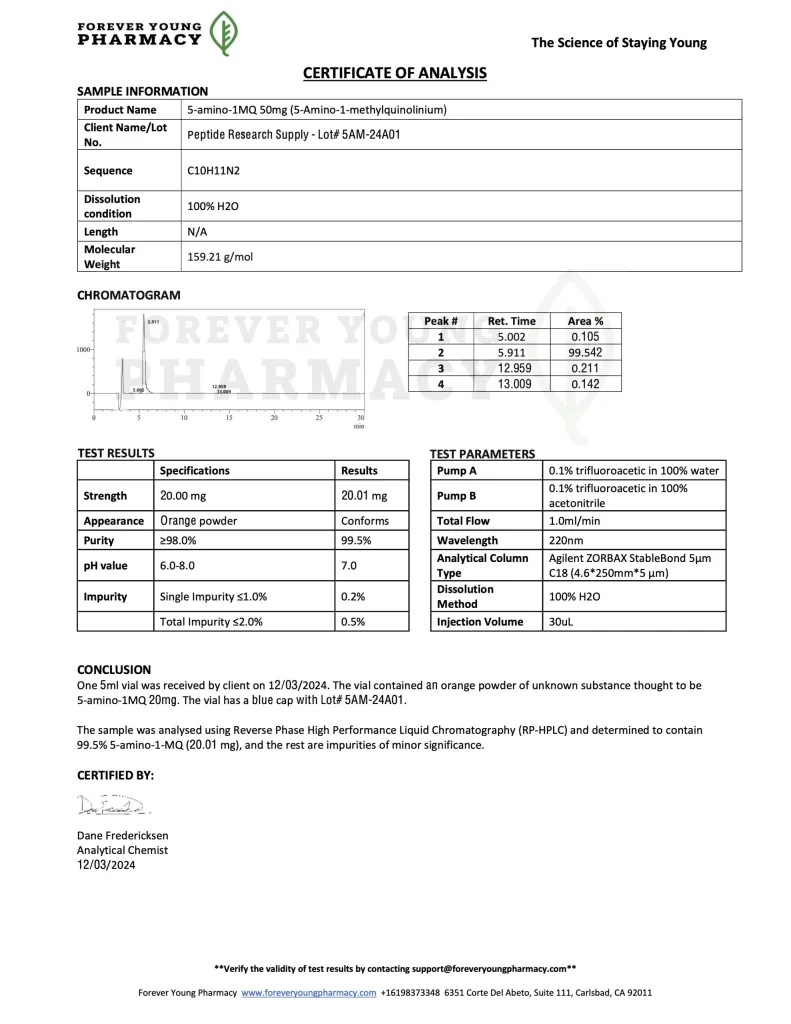
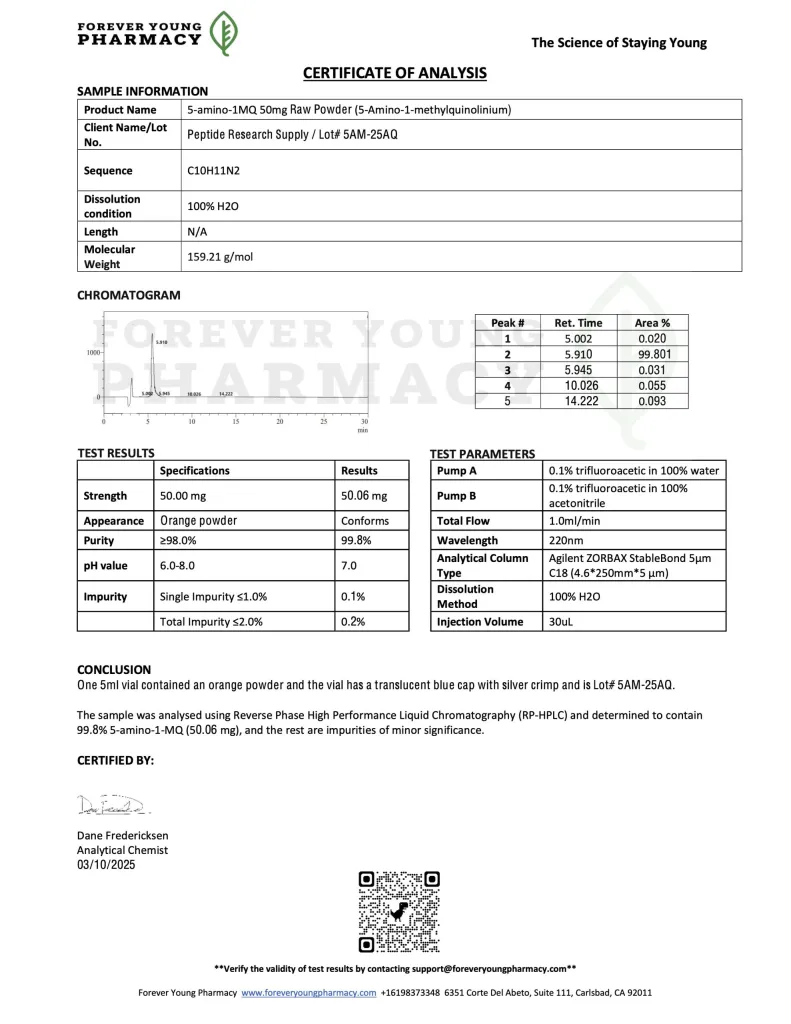
- Purity : ≥99% (HPLC Verified)
- State : Crystalline Powder
- Solubility : Soluble in DMSO; Moderate in Water
Technical Note : Most research protocols utilize the Iodide Salt form for stability. The cation alone has a MW of ~159.21 g/mol, but the functional reagent supplied is the salt (MW 286.11 g/mol). Ensure calculations account for the salt weight during stoichiometry.
Disclaimer : For Research Use Only (RUO). Not for human use.
Product Overview
Product Format : Lyophilized Crystal/Powder (Vial)
Grade : Reference Material (≥99% HPLC) | CAS: 42464-96-0
5-Amino-1MQ represents a distinct class of metabolic research chemicals. While GLP-1 agonists modulate satiety signaling, 5-Amino-1MQ operates intracellularly by inhibiting NNMT. Research indicates that elevated NNMT activity is linked to compromised NAD+ availability and increased adiposity.
By blocking this enzymatic pathway in research models, 5 Amino 1MQ is utilized to study:
- Cellular Bioenergetics : Restoring the cytosolic NAD+/NADH ratio.
- Adipocyte Phenotypes : Investigating the reduction of lipogenesis (fat accumulation) without killing the cell.
- Myogenic Differentiation : 2026 data suggest potential applications in reversing sarcopenia (muscle wasting) markers in aged tissue models.
Chemical Identity & Mechanism
Mechanism of Action : The “Methyl Sink” Blockade
NNMT Inhibition : The enzyme NNMT consumes Nicotinamide and S-Adenosylmethionine (SAMe) to produce 1-Methylnicotinamide (1-MNA). This process is often called the “Methyl Sink” because it drains the cell of energy precursors.
NAD+ Restoration : By inhibiting NNMT, 5-Amino-1MQ prevents this drainage, theoretically increasing the pool of NAD+ available for Sirtuin activation and mitochondrial function.
Adipocyte Bioenergetics : Cellular Assays (2017-2025) demonstrate that treated adipocytes show reduced volume and downregulated lipogenic gene expression.
Chemical Diagram
Chemical Diagram of 5-Amino-1MQ

5 Amino 1MQ Iodide Salt Structure | 2D Chemical Diagram | CAS 42464-96-0 | NNMT Inhibitor Reagent
Molecular Specification. The verified 2D diagram of 5-Amino-1MQ (Iodide Salt). Researchers must note the presence of the Iodide counterion shown here, which establishes the correct Molecular Weight (286.11 g/mol) for stoichiometric calculations in enzymatic assays.
Regulatory Status : Research Use Only (RUO). Not for human consumption, diagnostic, or clinical use.
Comparative Research Context :
Metabolic Modulator Comparison
| Feature | 5-Amino-1MQ | Tirz (Dual-A) | Tesofensine |
|---|---|---|---|
| Class | Small Molecule Inhibitor | Dual Agonist (GLP-1/GIP) | Triple Monoamine Modulator (SNDRI) |
| Primary Target | Intracellular NNMT Enzyme | Cell Surface Receptors | CNS Reuptake Transporters |
| Bio-Mechanism | NAD+ Salvage / Bioenergetics | Insulinotropic Signaling | Dopaminergic Modulation |
| Key Research Area | Sarcopenia & Adipocyte Metabolism | Glycemic Regulation | Neuro-Metabolic Pathways |
| Cellular Effect | Increases Basal Metabolic Flux | Delays Gastric Motility | Modulates Satiety Signaling |
Practical Interpretation for Researchers
Select 5 Amino 1MQ for protocols focusing on cellular metabolism, muscle tissue preservation (sarcopenia), and NAD+ pathways.
Select Tirz (Dual-A) for incretin-based signaling models.
Note : 5 Amino 1MQ is often studied in “Combination Protocols” alongside peptides, but operates via a completely distinct, non-hormonal pathway.
HANDLING & STABILITY
- Storage : Store at -20°C ideally, or cool dry place protected from light. The hydroscopic nature requires desiccation.
- Reconstitution : Soluble in water, but DMSO is recommended for stock solutions to prevent precipitation in high-concentration assays.
- Safety Warning : Contains Iodide. May cause skin and eye irritation. Use strictly in a fume hood with appropriate PPE.
Why Researchers source from PROFOUND AMINOS
1 – Validated Salt Stoichiometry : Many grey-market vendors confuse the Cation MW (159.21) with the Salt MW (286.11), leading to massive titration variance (calculation errors) in stock solutions. Our Standard: We explicitly label and supply the Iodide Salt form, ensuring your Molar concentrations are accurate for enzymatic assays.
2 – USA Cold-Chain Integrity : While stable at room temperature, NNMT inhibitors can degrade under extreme heat during transit. Our Protocol We maintain a strictly monitored USA Supply Chain, shipping from climate-controlled facilities to preserve crystal lattice integrity.
3 – “Post-GLP-1” Research Ready : As the market shifts from simple satiety peptides to complex metabolic modulators, our 5-Amino-1MQ is tested specifically for NAD+ Salvage Pathway activity, aligning with the 2026 research focus on “Bioenergetic Optimization.”
REGULATORY & COMPLIANCE STATEMENT
Regulatory Classification & Usage Disclaimer: This product is strictly classified as a Chemical Reference Standard for Research Use Only (RUO) .
It is NOT a sterile pharmaceutical ingredient (API), dietary supplement, or drug intended for human or veterinary consumption. This compound has not been evaluated by the FDA for safety or efficacy in clinical applications; any use involving bodily introduction (injection/ingestion) is strictly prohibited and violates federal compliance protocols.
FDA Warning : 5 Amino 1MQ is an unapproved new drug. The FDA has not evaluated it for safety or efficacy in humans. Selling or using this product for “Biohacking” or personal use is a violation of federal law.
Safety : The Iodide salt form is a chemical irritant.
H302 : Harmful if swallowed.
H315 : Causes skin irritation.
H319 : Causes serious eye irritation.
Protocol : Handle only in a laboratory setting with Nitrile gloves and safety goggles
Frequently Asked Questions
Q: What is 5‑Amino‑1‑MQ and how does it work ?
A: 5‑Amino‑1‑MQ is a small quaternary ammonium compound (not a peptide). In cell and animal studies, it acts as a selective inhibitor of nicotinamide N‑methyltransferase (NNMT). By blocking this enzyme, it increases cellular NAD⁺ and S‑adenosylmethionine levels and decreases 1‑methylnicotinamide, which may influence energy metabolism
Q: Is this product approved for human use or body composition improvement ?
A: NO. This material is a lyophilized Chemical Reference Standard designed strictly for Isolated Cell Culture Protocols. It is not an FDA-approved drug, dietary supplement, or sterile pharmaceutical ingredient (API).
Q: Is 5‑Amino‑1‑MQ a peptide ?
A: No. Although some marketing websites call it a “peptide,” it is chemically a small molecule derived from quinoline. Research suppliers note that it is for laboratory use only, not for human or veterinary use.
Q: What evidence supports its effects in animal models ?
A: Pre‑clinical studies have shown promising yet preliminary effects. A 2017 study found that 5‑Amino‑1‑MQ reduced body weight, fat mass and cholesterol levels in obese mice. A 2024 study reported that aged sedentary mice given 5‑Amino‑1‑MQ experienced ~40
% improvement in grip strength, and combining it with exercise yielded ~60 % improvement. No comparable human data exist.
Q: 5 What are the known safety concerns ?
A: Safety data sheets classify the iodide salt as harmful if swallowed and irritating to skin, eyes and respiratory tract. Researchers emphasize that toxicology, long‑term effects and appropriate dosing remain unknown in humans.
Q: Why is the Molecular Weight listed as 286.11 g/mol ?
A: We supply the Iodide Salt Form (C₁₀H₁₁IN₂) for enhanced stability. The cation alone is ~159 g/mol, but the salt form (286.11 g/mol) must be used for accurate Molar Titration calculations in enzymatic assays.
Q: Can it be legally marketed or advertised in the U.S. ?
A: Google’s 2026 advertising policies prohibit ads for non‑government‑approved pharmaceuticals and supplements or products promoted as safe or effective for treating disease. The FDA has also issued warning letters to companies marketing peptides for human use under “research use only” labels. Sellers may legally offer these compounds for laboratory research but not for human treatment.
Q: What future directions do researchers suggest ?
A: Review articles emphasize optimizing selective NNMT inhibitors like 5‑Amino‑1‑MQ and exploring co‑administration with NAD⁺ precursors for cardiometabolic disorders. However, translation to human therapies requires rigorous clinical trials to establish safety and efficacy.
Q: How does NNMT inhibition affect cellular metabolism ?
A: By inhibiting the NNMT enzyme, 5-Amino-1MQ prevents the “methyl sink” effect. This theoretically preserves the cytosolic pool of NAD+ (Nicotinamide Adenine Dinucleotide), which is critical for sirtuin activation and mitochondrial oxidative phosphorylation.
Q: Can this be used in combination with GLP-1 agonists in research ?
A: Yes. Many 2026 protocols investigate “Dual-Pathway” models, combining Tirz (Dual-A) (for receptor signaling) with 5 Amino 1MQ (for intracellular bioenergetics) to observe distinct metabolic effects on adipocytes.


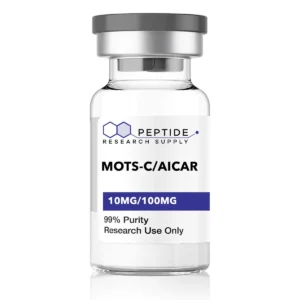 MOTS-C/AICAR 10mg/100MG
Reviews
There are no reviews yet.